Can
Your Business Make It in China?
By FBWorld Team
China's
recent economic boom and a population of 1.3 billion people,
has quickly made China the "Holy Grail" for
all businesses around the world. Their seemingly unquenchable
thirst for luxury and imported items has made China one
of the top markets for export goods. It's estimated that
20% of the population controls 80% of the country's wealth.
While that may seem like a small number, consider that
20% of China's population is 260 million people, roughly
the entire population of the United States. Successfully
selling your products in China can shoot you to a Wal-Mart
level stratosphere. Success can provide profits that dwarf
domestic revenues. Just ask KFC, which owns the Chinese
fast food market; even with many of its US stores bordering
in the "red" it's looking at huge corporate
profits. But failure can be disastrous or at least embarrassing.
Ask
Home Depot, a corporation who is forced to close all seven
of their big box stores in China. Even with Home Depot's
internationally recognized brand, deep pockets, in conjunction
with China's booming real estate market; Home Depot could
not pull out a "win" or even a "draw"
in China. But competitors such as IKEA are enjoying a
fair level of success. Why? Is IKEA just better that Home
Depot? No. Home Depot did not seriously recognize difference
in cultures and people's attitudes toward their products.
While
China is a foreign country, it can feel like a foreign
planet at times. Trying to do business there you first
have to forget everything you know about the U.S. market.
It seldom applies. The cultural complexities are woven
into everyday life and ingrained in their thinking. The
Chinese consumer is a completely different species than
that of the American one. It's very easy to fall into
the idea that "it works so well here, then they'll
be clamoring for it over there." Home Depot offers
a paradise for do-it-yourselfers.
Unfortunately,
China is not a do-it-yourself country. With labor cost
so low in comparison, people hire workers (sometimes off
the street) to do the installation. The Chinese consumer
doesn't want everything under the sun in one place; they
want to go to a market with shop after shop selling the
same things. There they feel they have the largest selection
and the ability to negotiate the best deal.
One
of the most successful business strategies in China is
Starbucks. When Starbucks first announced that they were
going into China, the pundits all laughed at them. The
idea of trying to sell coffee to a tea-drinking nation
was comical. To charge for a cup of coffee the price of
a meal is even more ridiculous. Yet Starbucks is one of
the great U.S. to China success stories.
Starbucks
wasn't selling coffee to the Chinese, they sold to the
Chinese what they really wanted, the American lifestyle.
Large shops walled in glass with free wi-fi allowed people
there to feel like Americans. With their laptops out,
they would sit there with their mug and feel cosmopolitan.
More importantly, they were seen by others to be this
way. Soon everyone wanted to feel this way and Starbucks
took-off.
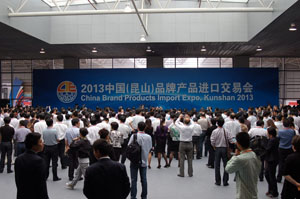
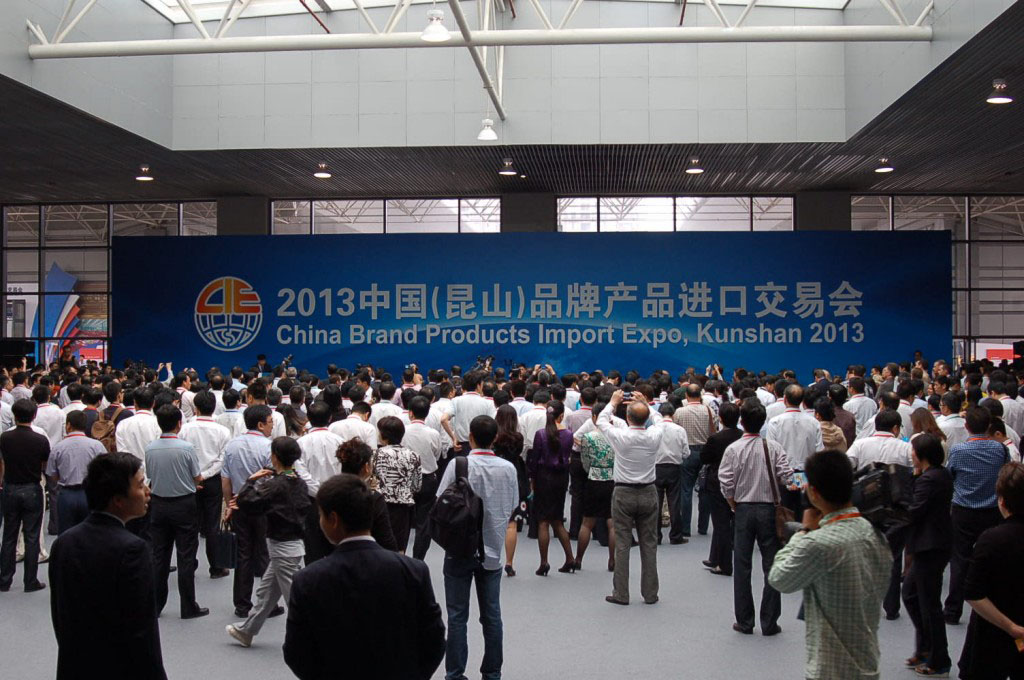
Expo in Kunshan
What
ever you learned in business school scarcely applies to
doing business there. The first and last thing in business
in China is called "guanxi."
Translated
as "relationships," it is what all businesses
in China are based. The Chinese businessman does not look
at your company; he looks at you. Are you capable? Are
your trustworthy? Your personal relationships with other
businessmen and Government officials can be everything.
Business is almost never conducted at the office. Real
business is conducted at dinner in private rooms with
alcohol.
Tolerance
for alcohol is a necessity to do business in China. They
must first feel comfortable with you before even considering
business. The Chinese only do business with "friends."
Because of its social connotations, drinking has ingrained
itself as a part of doing business. A typical Chinese
businessman will conduct these dinners 5-6 nights a week.
While Americans buy alcohol by the bottle, the Chinese
buy alcohol by the case. But even drinking has specific
rules.
There
are a series of unspoken rules in drinking when conducting
business dinners. The highest-ranking person has the place
of honor facing the door. You must know the hierarchy
of everyone in the room. You must toast everyone in the
room and they will in turn toast you.
Respect
is shown as you toast the highest ranking person in the
room first and then on down the line. To truly show your
respect, your glass must be lower than theirs as they
clink. While such rules seem trivial and complex it is
the expected manner of doing business.
While
China is seen as a behemoth market, access to this market
by foreigners is limited. While the Chinese prefer imported
goods to their own, they prefer to do business with their
own. Your personal network is everything in business.
Only friends will open the door for you. The game is that
who can secure the most powerful friends. As business
goes, you can be the smartest person in the world and
still not make it in China. But, you could be the dumbest
and be related to Mao, then you will be rich.
By Steven Fan
Steven Fan is a Chinese American businessman living and
doing business in Chongqing, China. He has a Bachelor
of Arts degree in Mass Media Communications from NYU and
runs several successful import/export companies. You can
reach Steve Fan through Arthur Walsh at artw@fbworld.com,
all communication will be passed on to him.

|